

Google Ads
- 1. How much Google Ads costs: the real figures in 2026
- 2. Average CPC by sector in France: the price scale
- 3. Minimum budget: how much to invest to get started
- 4. Google Ads agency fees: pricing models
- 5. 6 factors that influence your costs
- 6. Calculate the ROI of your Google Ads campaigns
- 7. 5 ways to cut costs without sacrificing performance
- 8. Frequently asked questions
42% of Google Ads advertisers in France don't know the real cost of acquiring a lead via their campaigns. The CPC displayed in the interface only tells a fraction of the story. Between management fees, unqualified clicks and wasted budget on off-target queries, the Google Ads cost often exceeds twice what we imagine.
This guide details the real rates in 2026: average CPC by sector, minimum budget to get started, agency billing models, and concrete levers to optimize every euro invested in your campaigns.

How much does Google Ads cost: the real figures in 2026
The cost of Google Ads breaks down into three distinct items: the media budget paid directly to Google, management fees (internal or agency), and additional tracking and optimization tools. Ignoring one of these items means underestimating the bill by 30% to 50%.
Google charges cost per click (CPC) on Search and Shopping, or cost per thousand impressions (CPM) on Display. You only pay when a user interacts with your ad. The system works by bidding: you define a daily budget, and Google runs your ads until that budget is exhausted.
According to Google Economic Impact Report 2024, For every euro invested in Google Ads, advertisers generate an average of €8 in sales. An encouraging ratio, but one that masks considerable disparities between sectors and levels of maturity.
On a total budget of €5,000 per month, expect to spend around €3,750 to €4,250 on media, €500 to €1,000 on management costs, and €100 to €250 on tools. Your actual Google Ads cost includes these three dimensions.
Average CPC by sector in France: the pricing grid
The average CPC in France on the Search network will be between €0.80 and €2.50 in 2026. But this average has almost no operational value. A click in the insurance sector costs 12 times more than a click in food e-commerce.
According to WordStream 2025 data, CPC has increased by 10% on average over the last two years, driven by intensifying competition and the expansion of Performance Max campaigns.
These average CPCs conceal disparities of 1 to 10 within the same sector. On a tourism account we manage with a budget of €12,000 per month, the CPC on «Maldives trip» exceeds €4, while «last-minute stay in Greece» hovers around €0.60. The key is not to know the average CPC for your sector, but to map CPCs by search intent on your specific queries.
Google Ads minimum budget: how much to invest to get started
The minimum budget to launch profitable Google Ads campaigns is between €1,000 and €1,500 per month in 2026, excluding management fees. Below this level, the volume of data collected is too low for the algorithm to properly optimize your bids, and for you to draw statistically reliable conclusions.
The calculation is simple. If your average CPC is 2€ and your conversion rate is 3%, you need around 33 clicks to get one lead. At €2 per click, that's €66 per lead. To get 15 leads a month (a minimum to drive), you'd need to invest around €1,000 in media budget.
According to a study Statista 2025, The 68% of French SMEs investing in Google Ads spend between €1,000 and €10,000 per month on their media budget. The 15% who invest less than €500 per month have a platform abandonment rate twice as high in the first 6 months.
Our conviction at Digitalised: it's better to invest €1,500 a month for 3 months on a restricted perimeter (a geographical area, a product segment) than to sprinkle €500 a month over your entire catalog. The first 3 months are used to calibrate your bids, identify profitable queries and build up a Quality Score history. It's a learning investment, not an expense.
A mistake we see regularly You need to set aside a budget of €300 per month «for testing». At this level, you get 5 to 10 clicks a day, half of which are often unqualified in the launch phase. Conclusions drawn from so little data are statistically invalid. You run the risk of abandoning Google Ads, thinking that the platform isn't working, when in fact it's the budget that was insufficient.
Google Ads agency fees: pricing models
The price of a Google Ads agency ranges from €500 to over €5,000 per month, depending on pricing model, account complexity and media budget. Four models coexist on the French market in 2026.
Percentage of media budget
The most widespread model. The agency charges between 10% and 20% of the monthly media budget. For a budget of €10,000, management fees range from €1,000 to €2,000. The advantage: interests are aligned, since the agency has a vested interest in your budget being well spent. The risk: a bias towards increasing the media budget, even when this is not the priority.
Fixed monthly fee
A fixed amount, generally between €500 and €3,000 per month, whatever the evolution of the media budget. This model offers predictability in your management costs. It is suitable for stable budgets and well-defined perimeters.
Performance-based pricing
The agency is remunerated on the basis of results: cost per lead, percentage of sales generated, or target bonus. This model may seem attractive, but it creates the risk of a race for volume to the detriment of lead quality.
Hybrid model
A basic fee plus a performance-related variable. This is the model we use at Digitalised for accounts with a media budget of over €5,000. It guarantees a basic level of service while maintaining performance incentives.
Beware of «all-inclusive» offers at €300 per month. Having audited more than 50 Google Ads accounts using this type of offer, our findings are clear: in 80% of cases, management boils down to an initial setup followed by minimal follow-up. The agency has neither the time nor the margin to really optimize at this rate. Always ask for details of time spent and frequency of optimization.
Are you spending too much on Google Ads?
Our experts analyze your account and identify the levers to reduce your costs while increasing your conversions.
6 factors that affect your Google Ads costs
Six main variables determine what you actually pay on Google Ads. Understanding these factors means understanding why two advertisers in the same sector can pay a CPC ranging from one to four times.
1. Quality Score
Quality Score is the most influential factor on your Google Ads cost. This score from 1 to 10 assigned by Google measures the relevance of your ads, the quality of your landing page and your expected click-through rate. A Quality Score of 10 can reduce your CPC by 50% compared with the average, while a score of 1 can multiply it by 4. This is the number-one lever for optimizing your costs.
2. Sectoral competition
The greater the number of advertisers competing on a given query, the higher the CPC. Google's bidding system works like an auction: the price rises with demand. High-margin sectors (insurance, credit, legal) attract more bidders.
3. Geographic targeting
A campaign targeting Paris costs on average 20% to 40% more than a campaign targeting a provincial city. The density of advertisers in the Paris region automatically raises the stakes. Targeting less competitive areas can significantly reduce Google Ads costs for an equivalent budget.
4. Campaign type
Search campaigns have the highest CPCs, as they capture explicit intent. Shopping campaigns are generally 30% to 50% cheaper. The Display network offers the lowest CPCs (often under €0.50), but with a lower conversion rate. Campaigns Performance Max combine all networks and automatically adjust the distribution.
5. Seasonality
Google Ads costs fluctuate according to the time of year. Black Friday, Christmas and sales trigger CPC increases of 20% to 60% in e-commerce. In tourism, the January-March period concentrates summer booking searches, with CPCs at their highest. For one of our tourism customers, the average CPC rises from €0.90 in October to €2.10 in February.
6. Account structure
A poorly structured account wastes budget. Ad groups that are too large, keywords in broad queries with no negatives, generic landing pages: all these factors degrade Quality Score and increase CPC. Having restructured over 50 accounts, our observation is consistent: a better account structure reduced CPC from 15% to 30% in 3 months.
Calculate the ROI of your Google Ads campaigns
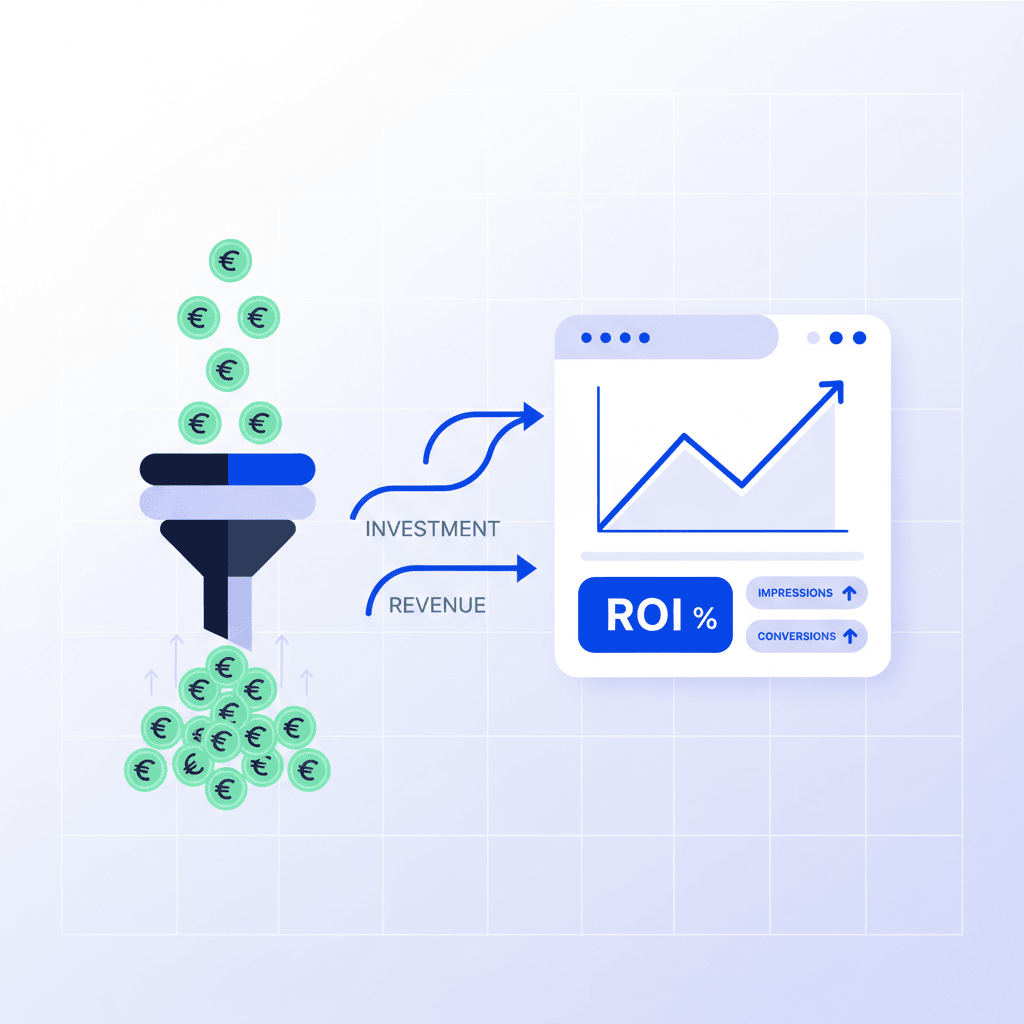
Google Ads ROI is calculated by comparing the sales generated by your campaigns with the total investment (media budget + management costs + tools). The basic formula : ROI = (Revenues - Costs) / Costs × 100. An ROI of 200% means that every euro invested has returned 3.
Let's take a concrete example. You invest €3,000 per month in media and €600 in agency fees (total: €3,600). Your campaigns generate 150 qualified clicks per day, with a conversion rate of 3%. That's 135 leads per month. If your closing rate is 15% and your average shopping basket is €2,000, you'll generate €40,500 in sales. Your ROI: 1,025%.
But be careful: there are three metrics that really count when it comes to managing your Google Ads costs.
- CPA (cost per acquisition) measures how much each conversion costs you. This is the metric you use every day.
- ROAS (Return on Ad Spend) compares sales to advertising budget. A ROAS of 5 means that €1 invested generates €5 in revenue.
- LTV (Lifetime Value) integrates customer value over the entire duration of the relationship. A high CPA can be profitable if LTV is high.
Contrary to popular belief, ROAS alone is a misleading indicator. On a B2B account we manage at Digitalised, the ROAS displayed is 3 (apparently average). But the LTV of a customer acquired via Google Ads is €45,000 over 3 years. At a CPA of €180, the real profitability is spectacular. Never manage your acquisition budgets on ROAS alone.
5 ways to reduce your Google Ads costs without sacrificing performance
Reducing the cost of Google Ads doesn't mean cutting the budget. It means eliminating waste and redirecting every euro to clicks that convert. Here are the 5 levers we systematically activate during a campaign. account audit.
1. Enrich negative keyword lists
Negative keywords are the fastest and most effective lever. Each week, analyze the search term report in Google Ads Editor and exclude irrelevant queries. On the accounts we take over, the first pass of negatives generally reduces the wasted budget from 15% to 25%.
2. Working on Quality Score
There are three components to optimize: ad relevance (text must match search terms), landing page experience (speed, appropriate content), ergonomics), and the expected CTR. According to Google, For example, going from a Quality Score of 5 to 7 reduces the CPC by an average of 28%.
3. Exploiting ad extensions
Extensions (side links, teasers, site extracts, calls) increase the visible size of your ad and improve CTR from 10% to 15%. A better CTR improves Quality Score, which reduces CPC. It's a virtuous circle that's often under-exploited.
4. Optimize bidding strategies
Manual bidding gives you control, but automatic strategies (Target CPA, Target ROAS, Maximize Conversions) often outperform manual bidding as soon as the account has 30 conversions per month. Google's algorithm adjusts bids in real time according to signals you can't process manually: device, time, location, browsing history.
5. Segment by zone and time slot
Analyze performance by geographic area and time of day in the «Dimensions» tab of Google Ads. If your conversions are concentrated between 8am and 8pm on weekdays, reducing bids from 30% to 50% at night and weekends can generate substantial savings without losing qualified leads. We apply this segmentation to all the accounts we manage at Digitalised.
Frequently asked questions about Google Ads costs
What is the average cost of a click on Google Ads in France?
The average cost of a click on Google Ads in France will be between €0.80 and €2.50 on the Search network in 2026. This figure varies considerably by sector: tourism has an average CPC of €0.80 to €2.50, while insurance regularly exceeds €10 per click. The Display network is considerably cheaper, with an average CPC of €0.10 to €0.60. These averages mask significant variations depending on local competition, the quality of your ads and your Quality Score.
Can you make €500 a month from Google Ads?
Yes, but with important limits. A budget of €500 per month on Google Ads allows you to test a market or target a restricted geographic niche. With an average CPC of €1.50, this represents around 330 clicks per month, or 11 clicks per day. If your conversion rate is 3%, you'll get around 10 monthly leads. For a profitable, scalable strategy, most sectors require a minimum of €1,000 to €1,500 per month, excluding management fees.
How much does an agency charge to manage Google Ads?
Google Ads agency fees vary according to pricing model. The percentage of the media budget varies between 10% and 20% (i.e. €500 to €4,000 for a media budget of €5,000 to €20,000). The monthly fee ranges from €500 to €3,000, depending on the complexity of the account. Some agencies charge on a performance basis, with a cost per lead or a percentage of sales generated. The hybrid model (fixed + variable) is becoming increasingly common in 2026.
Is Google Ads more expensive than Meta Ads?
In terms of pure CPC, Google Ads is generally more expensive than Meta Ads. The average CPC on Facebook and Instagram is between €0.30 and €1.20, compared with €0.80 to €2.50 on Google Search. But this comparison is misleading. User intent on Google is often stronger: someone typing a precise query is further along in their buying journey than a user targeted on Meta. The final cost per acquisition is often comparable, or even lower on Google for queries with strong commercial intent.
How can I reduce the cost per click on Google Ads?
There are five main ways to reduce your CPC on Google Ads. Improve your Quality Score by working on the relevance of your ads and the quality of your landing pages. A Quality Score of 10 can reduce your CPC by 50% compared with the average. Enrich your negative keyword lists to eliminate unqualified clicks. Use ad extensions to improve your CTR. Test automatic bidding strategies such as Maximize Conversions. Segment your campaigns by geographic zone and time slot.
What Google Ads budget should you set aside for your e-commerce business?
For an e-commerce business, the recommended Google Ads budget in 2026 is between €1,500 and €5,000 per month to get started, divided between Shopping (60-70%), Search (20-30%) and Performance Max (10-20%). The average Shopping CPC is €0.20 to €1, more affordable than Search. According to Google, Shopping campaigns generate an average ROAS of 4 to 8 for well-optimized e-tailers. For a catalog of over 500 products, you'll need a budget of over €3,000 per month to cover enough queries.
Want to know what Google Ads can really do for you?
Before increasing your budget or changing agencies, the first step is to find out where your euros are going today. Not a theoretical audit, an operational diagnosis with quantified recommendations.
A specialist in digital acquisition, Julia helps companies optimize the creation of digital content. She deciphers Google Ads strategies and paid marketing trends to help decision-makers invest more effectively.